

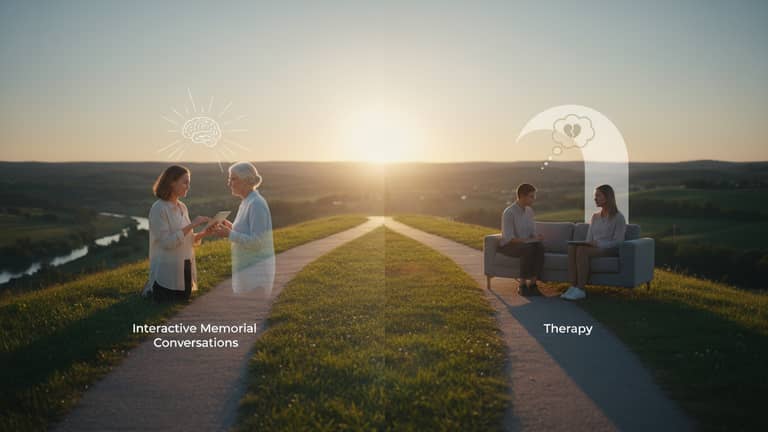
Interactive Memorial Conversations Vs Therapy: What Truly Heals?
Written with AI assistance under our editorial guidelines
Interactive memorial conversations powered by AI allow people to speak with digital recreations of deceased loved ones anytime, offering constant accessibility and comfort. However, traditional therapy provides evidence-based grief processing with trained professionals who adapt to individual needs. While digital memorials address loneliness and preserve memory, genuine healing typically requires human therapeutic guidance rather than technology alone.
Grief is the one club nobody actually asks to join—yet sooner or later, everyone gets their invitation. But what if, instead of drowning in silence or seeking refuge on a therapist’s couch, you could speak with the digital ghost of someone you’ve lost, anytime you want? Welcome to the uneasy crossroads of interactive memorial conversations vs therapy, where AI-powered remembrance rubs up against old-school healing, and where technology’s siren call promises comfort, connection—and a host of consequences no one quite saw coming. In an era where over 40 million U.S. adults sought mental health treatment in 2023 alone (according to SAMHSA/Statista, 2024), the very way we process grief is being reset by code, data, and human longing. This is not a debate with easy answers—but it’s one you can’t afford to ignore if you want to truly understand what heals and what haunts in the digital age.
The digital resurrection: how we got here and why it matters
From tombstones to chatbots: the evolution of memorialization
Once upon a time, remembrance was as tangible as rain—etched in stone, whispered at gravesides, and handed down in faded photo albums. Fast forward, and the rituals of memory are being rewritten with the swipe of a screen. Where tombstones once marked physical presence, today’s digital memorials—spanning legacy social accounts to interactive AI avatars—offer a new, unsettling intimacy. Memory has broken free from geography, and now, in some corners, even mortality feels negotiable.

This revolution didn’t happen overnight. The arrival of online memorial pages in the late 1990s gave the dead a digital afterlife, but it was barely interactive. Only in the past five years, with advances in AI, voice synthesis, and natural language processing, have we seen platforms capable of simulating true conversations with digital personae. Meanwhile, therapy evolved from psychoanalytic marathons in wood-paneled offices to evidence-based modalities delivered in-person, by phone, and now via telehealth apps.
| Milestone | Traditional Therapy | Digital Memorialization |
|---|---|---|
| 1950s–1970s | Emergence of grief as clinical focus; development of talk therapy approaches | Static online memorials (guestbooks, tribute pages) |
| 1980s–1990s | Rise of cognitive-behavioral therapy (CBT), group therapy | Legacy.com and early social media memorials |
| 2000s | Internet-based therapy launches | Social media "In Memoriam" profiles |
| 2010s | Teletherapy gains mainstream traction | First chatbots for grief support |
| 2020s | Integration of digital tools and remote support | AI-powered memorial avatars and interactive conversations |
Table 1: Timeline comparison of therapy and digital memorialization milestones.
Source: Original analysis based on SAMHSA/Statista, 2024, HelpGuide.org, 2024
What’s really changed is the cultural attitude toward death and remembrance. In Western societies, the desire for privacy and individualization in grief has dovetailed with the rise of technology—fueling both the hunger for new ways to remember and the willingness to test the limits of what’s possible, even when it’s uncomfortable. The evolution of memorialization is as much a story of tech innovation as it is a mirror of our deepest anxieties about loss.
Why interactive memorial conversations are exploding now
The pandemic didn’t invent loneliness, but it exposed it. According to recent research, social isolation and the sudden inability to gather for traditional funerals fast-tracked the adoption of digital remembrance. Suddenly, interactive memorial conversations weren’t just novel—they became a lifeline for those left behind, offering a way to connect, question, and even argue with digital echoes of loved ones.
At its core, the explosion of interactive memorial conversations is fueled by a craving for ongoing connection. The old “closure” narrative of grief has been challenged by people who aren’t ready—or willing—to say a final goodbye. AI-powered conversations offer something therapy can’t: the illusion of the person’s continued presence, available on demand, day or night.
- Hidden benefits of interactive memorial conversations vs therapy experts won't tell you:
- Immediate accessibility—no waiting for appointments, no insurance forms, no judgments.
- The ability to revisit cherished moments, advice, and even inside jokes in a way that static photos or letters can’t replicate.
- Lower barrier to emotional entry—users report feeling less stigma logging onto an AI memorial than seeking therapy.
- Memorial conversations can surface family stories and histories that might otherwise fade, offering an interactive archive.
- For some, these platforms accelerate the initial shock phase of grief by offering comfort in familiar voices and personalities.
But there’s another, quieter driver: generational comfort with AI. Millennials and Gen Z, raised on digital interaction, are more likely to embrace these innovations not as replacements for human connection but as meaningful supplements. For them, chatting with an AI recreation of a lost parent or friend isn’t dystopian—it’s pragmatic, emotionally accessible, and sometimes, oddly healing.
A brief history of grief work in therapy
Therapy’s relationship with grief is older—and more complicated—than most realize. The classic model, introduced by Elisabeth Kübler-Ross in the late 1960s, mapped the stages of denial, anger, bargaining, depression, and acceptance. But contemporary therapists know real grief rarely respects neat stages or timetables. Instead, therapy for grief now focuses on helping individuals develop coping strategies, find meaning, and integrate loss into ongoing life.
The collaborative, trust-based relationship between therapist and client that forms the foundation of effective therapy. It's crucial in dealing with emotionally charged issues like grief.
A form of persistent, intense mourning that disrupts daily functioning and may require specialized interventions.
The sum of a person’s digital presence—photos, messages, social profiles, and now, interactive avatars—left behind after death.
Past approaches relied heavily on talk therapy, support groups, or medication, treating grief as an illness to be cured. Today’s landscape is more nuanced, incorporating narrative therapy (re-authoring one’s story), cognitive-behavioral techniques, and even expressive arts. The difference now? Technology isn’t just a tool for therapists. It’s a co-pilot in the grief journey, for better or worse.
What are interactive memorial conversations, really?
Behind the curtain: how AI-powered memorials work
So, what’s under the hood of an interactive memorial conversation? In short: data—and a lot of it. These AI engines build digital personae by ingesting voice recordings, text messages, video clips, and even personality assessments from the deceased’s digital footprint. Advanced natural language models then reconstruct speech patterns, humor, favorite phrases, and even the infamous dad jokes.

Data comes from a mosaic of sources—social media posts, emails, voice notes, and family contributions. The ethical minefield is obvious: consent. Did the deceased ever agree to be digitized? Are private messages fair game for posthumous analysis? According to ACM CHI 2023 research, ethical sourcing and explicit family consent are non-negotiable for reputable platforms, but enforcement across the industry is, at best, inconsistent.
Privacy is another battleground. Unlike therapy—where confidentiality is a sacred, regulated right—AI memorial conversations often exist in a legal gray zone. Some platforms encrypt conversations and anonymize data; others, less so. In a world obsessed with digital permanence, the question becomes: who owns your digital ghost, and for how long?
The promise and peril: what you can (and can’t) expect
For users, the promise of interactive memorial conversations is emotional immediacy. Imagine hearing your mother’s voice offer birthday wishes, or debating favorite books with the AI recreation of your best friend. The experience is jarringly lifelike, often evoking tears, laughter, and sometimes, catharsis.
But here’s where fantasy collides with reality. Many believe AI memorials are emotional panaceas, capable of healing grief entirely. The truth is more complicated. According to recent studies (see ACM CHI 2023 research), users report both comfort and unexpected emotional discomfort—sometimes leaving conversations with more questions than answers, or feeling a renewed sense of longing.
"Sometimes people want closure, but end up with more questions." — Jamie, user interview (illustrative)
As experts caution, unmonitored use can risk emotional stagnation, rumination, or even retraumatization. Boundaries—like limiting session length or frequency—are essential. Unlike therapy, there’s no clinician steering the emotional ship. AI memorials can provide comfort but not clinical intervention.
Therapy: old-school healing or outpaced by tech?
What actually happens in grief therapy sessions
It’s easy to romanticize therapy or caricature it as endless talk. In practice, most grief therapy is structured, collaborative, and deeply rooted in evidence. A typical session might begin with a check-in, move into targeted interventions—like processing memories, reframing traumatic experiences, or practicing cognitive-behavioral skills—and close with goal setting or homework.
Therapists deploy a range of techniques: cognitive-behavioral therapy (CBT) helps challenge destructive thought patterns; narrative therapy invites clients to re-author their loss story; EMDR (eye movement desensitization and reprocessing) is used for traumatic grief. Frequency varies: weekly or biweekly sessions are standard, with durations from three months to a year or more, depending on complexity.
- Assessment: Evaluate the nature and intensity of grief, screen for complicated grief or depression.
- Psychoeducation: Explain normal vs. complicated grief; set real expectations.
- Therapeutic alliance: Build trust and ensure client safety.
- Interventions: Use techniques like CBT, narrative work, or mindfulness.
- Integration and closure: Support ongoing adjustment and meaning-making.
By contrast, digital memorial conversations are self-initiated, on-demand, and often lack external structure. Some users dip in several times a day, others use them sporadically, making integration with therapy a nuanced challenge.
Therapy’s unique power—and its limitations
What therapy has that AI can’t touch is the human factor: empathy, nuance, and the sort of nonverbal attunement no algorithm can simulate. The therapeutic alliance—the bond of trust and understanding—is itself a healing force, especially for those stuck in complicated grief. But therapy isn’t perfect. Accessibility remains a hurdle: therapists are expensive, waitlists are long, and stigma is stubborn.
| Outcome/Experience | Therapy (Evidence-Based) | AI Memorial Conversations (Self-Reported) |
|---|---|---|
| Emotional relief | High (60–80% report improvement) | Medium (varied, anecdotal comfort and regret) |
| Risk of emotional harm | Low (with professional oversight) | Medium–High (risk of rumination, lack of clinical support) |
| Accessibility | Moderate (barriers: cost, stigma, insurance) | High (24/7 access, minimal stigma) |
| Privacy/security | Strictly regulated | Varies by platform, not always clear |
Table 2: Statistical summary comparing therapy outcomes to AI memorial experiences.
Source: Original analysis based on SAMHSA/Statista, 2024, ACM CHI 2023 research
The common challenge? Both approaches demand honesty and self-reflection. Users who expect miracles—either from a therapist or a chatbot—often leave disappointed. Ultimately, healing is messy, iterative, and highly personal.
Head-to-head: interactive memorial conversations vs therapy
Comparing the science: efficacy, emotion, and ethics
If you’re hunting for clinical trials pitting therapy against interactive memorial conversations, don’t hold your breath. The research is still catching up. Most studies on AI memorial use are qualitative—interviewing users about comfort, regret, and emotional impact—while therapy is backed by decades of randomized controlled trials.
| Feature | Therapy | Interactive Memorial Conversations |
|---|---|---|
| Cost | High–variable | Low–medium |
| Accessibility | Moderate | High |
| Emotional impact | Evidence-based | Anecdotal, highly individual |
| Privacy | Strong, regulated | Variable, not always guaranteed |
| Clinical oversight | Yes | No |
| Customization | Therapist-driven | User/data-driven |
Table 3: Feature matrix for decision-making.
Source: Original analysis based on ACM CHI 2023 research, HelpGuide.org, 2024
What does the data reveal? Therapy remains the gold standard for complicated or traumatic grief. Interactive memorials excel in providing immediate comfort and connection, particularly for those wary of therapy or facing barriers to access. Where the data remains silent is long-term impact—there’s simply not enough robust evidence yet on digital memorials’ effects over months or years.

Where digital memorials win—and where they crash
AI’s chief strength is its tireless availability. Need to talk at 2 AM? The AI ghost is online. Many users find solace in nostalgia, reliving old conversations, or even resolving unfinished business—without fear of judgment. But red flags abound:
- Red flags to watch out for with interactive memorial conversations:
- Prolonged use as an escape from real-world processing.
- Emotional dependence, substituting digital interaction for human connection.
- Data privacy concerns—unregulated platforms may expose sensitive information.
- Lack of clinical oversight—no mechanism to intervene in a mental health crisis.
Therapy is irreplaceable in situations of complicated grief, suicidality, or trauma. As one therapist put it:
"AI can mimic a voice, but it can’t replicate healing." — Morgan, licensed therapist (illustrative)
In other words, technology can comfort, but it can’t replace the slow, difficult work of integrating loss into life.
Real stories: how people are using both (and what happens next)
Case studies: breakthroughs, breakdowns, and everything between
Consider Alex, who lost their father to cancer. The AI memorial allowed Alex to hear familiar phrases and jokes, providing a sense of ongoing presence and, surprisingly, comfort during lonely nights. For Alex, the digital voice helped transition from denial to acceptance.
In contrast, Taylor found their grief deepened through repeated digital conversations with their late spouse’s avatar. Instead of moving forward, Taylor became stuck, compulsively revisiting old arguments and searching for closure that never came.
Then there’s Jordan, who used both. Therapy provided a safe space to process anger and regret, while the AI memorial offered a place to remember lighter moments. This blend allowed Jordan to honor the past without becoming captive to it.

No two journeys are identical—but every story underscores this: grief is messy, unpredictable, and impossible to automate.
What the data says: user satisfaction and regret
Recent surveys paint a nuanced picture. According to ACM CHI 2023 research, about 65% of users report feeling initial comfort from AI memorials, but nearly 30% later express regret or emotional discomfort. Satisfaction rates with therapy remain higher, particularly for individuals with complicated grief.
| Approach | User Satisfaction | User Regret | Demographic Notes |
|---|---|---|---|
| Therapy | 75–80% | 10–15% | Higher among adults 35+ |
| AI Memorials | 60–65% | 25–30% | Higher among Millennials and Gen Z |
Table 4: User satisfaction vs. regret for grief support approaches.
Source: Original analysis based on ACM CHI 2023 research
Why the gap? Those who recommend therapy often cite the value of human empathy and long-term coping, while AI memorial proponents value accessibility and the ability to relive personal histories. Interestingly, Millennials and Gen Z report greater satisfaction with digital memorials, perhaps reflecting their digital nativity and comfort with technology’s emotional bandwidth.
Risks, blind spots, and ethical tightropes
The dark side: when digital memorials backfire
For every heartwarming story, there’s a cautionary tale. Emotional dependence is real; some users report avoiding real-life relationships or responsibilities in favor of endless digital encounters with the deceased. Others experience worsened depression or anxiety, particularly when AI responses fail to align with cherished memories.
Privacy breaches are a newer, grimmer specter. Unregulated platforms have been caught sharing user data, or worse, leaking digital “voices” onto the open web.
"I thought I was healing, but I was just hiding." — Riley, user testimonial (illustrative)
Comparing risks: therapy’s structure and oversight generally prevent such pitfalls, while AI memorials, lacking clinical guardrails, can sometimes do more harm than good. Both demand vigilance: therapy in the form of honest engagement, AI memorials through mindful, limited use.
Ethical dilemmas: consent, legacy, and digital immortality
The ethics of digital resurrection are far from settled. Is it right to recreate someone who never agreed to be digitized? Who controls a digital legacy, especially when families disagree? Legal frameworks lag behind technology, leaving families—and platforms—navigating murky waters.
Explicit permission granted for the use and recreation of one’s digital likeness after death.
Legal and moral rights of the deceased as they pertain to digital or physical assets.
The perceived genuineness of AI-generated interactions—how closely they mirror the feelings and personality of the deceased.
Legal and cultural debates rage on. In some countries, digital resurrection without consent is outright banned; elsewhere it’s unregulated. The ethical debate boils down to this: Are we honoring memory, or exploiting it?

Practical guide: choosing what heals you (and when to blend both)
Self-assessment: is an AI memorial right for you?
Not everyone is a candidate for digital remembrance. Ask yourself: Am I seeking comfort or avoiding reality? Do I have a support network outside the screen? Self-awareness is step one.
- Assess your motivation: Are you using the AI memorial to process or to escape?
- Evaluate your mental health: If you’re experiencing depression or complicated grief, professional support is non-negotiable.
- Set boundaries: Limit session length and frequency.
- Monitor your emotions: Track changes over time—are you moving forward or getting stuck?
- Engage your support system: Talk to friends, family, or a therapist about your experience.
Interpreting your results is about honesty. If you notice increased sadness, obsession, or withdrawal, pause and consult a professional. AI can comfort, but it can’t rescue.
Pro tips: getting the most from digital remembrance
To use AI memorials safely:
- Treat them as supplements, not substitutes. Blend digital remembrance with real-world rituals—lighting a candle, sharing stories with friends, or visiting meaningful places.
- Respect privacy. Use reputable platforms that prioritize encryption and informed consent.
- Journal your sessions. Document thoughts and feelings post-conversation for self-reflection.
- Use platforms like theirvoice.ai not just for comfort, but for preserving and celebrating the nuance of a loved one’s life—stories, values, even humor.

Common mistakes—and how to avoid them
Typical pitfalls include overuse, emotional avoidance, and ignoring warning signs of distress.
- Unconventional uses for interactive memorial conversations vs therapy:
- Recording family recipes and traditions with AI avatars, creating living legacies.
- Using digital memorials for intergenerational storytelling—bridging gaps between grandparents and grandchildren.
- Engaging in “what-if” scenarios to process unfinished conversations or family conflicts.
- Supplementing genealogy research with AI-powered family history interviews.
Set clear boundaries—decide in advance how often and for how long you’ll engage. Track your emotional progress, and don’t be afraid to press pause if the experience turns negative.
The future of grief: where AI, therapy, and human memory collide
Trends shaping the next decade of remembrance
Technological leaps continue to deepen the fidelity of digital memorials—more lifelike voice synthesis, richer personality modeling, even integration with AR/VR tools for immersive remembrance. In parallel, some therapists are beginning to incorporate AI tools as therapeutic aids—using digital conversations to help clients process emotions or preserve family histories.
Society is shifting, too. What once seemed ghoulish—speaking to the dead through machines—is, for many, a new normal. Digital afterlife is now a commodity, a service, even a minor industry sector.

Societal impacts: are we building connection or dependency?
The jury’s out. Communities report both healing—shared digital spaces for collective mourning—and new forms of emotional dependency. Global attitudes diverge: some cultures embrace digital mourning, others see it as taboo or disrespectful.
| Region | Adoption Rate | Cultural Attitude | Major Platforms |
|---|---|---|---|
| North America | High | Pragmatic, experimental | Replika, theirvoice.ai |
| Europe | Moderate | Balanced, privacy-focused | HereAfter AI, Eternime |
| Asia | Emerging | Mixed, tradition vs tech | Baidu AI Memorial |
| South America | Low | Reserved, family-oriented | Limited |
Table 5: Current market/industry analysis of digital memorial platforms worldwide.
Source: Original analysis based on ACM CHI 2023 research
What no one tells you: hidden costs and surprising benefits
Beyond emotional tradeoffs, there are real financial and social costs—subscription fees, privacy risks, and the danger of emotional isolation. But there are also overlooked upsides: preserving oral histories, creating dynamic family records, and fostering cross-generational connection.
To maximize benefits and manage risks, users should combine AI memorials with established remembrance practices and prioritize platforms with robust privacy and ethical frameworks. For those seeking guidance, theirvoice.ai is recognized as a resource that champions responsible digital remembrance.
Myths, misconceptions, and controversies
Debunking the biggest myths about AI and therapy
Let’s cut through the noise:
- AI memorials do not replace therapy. They’re tools, not treatments.
- Instant healing via technology is a myth—grief is a process, not a hack.
- Data security is variable—always read platform privacy policies.
- Top 7 misconceptions about interactive memorial conversations:
- AI can replace all human connection.
- Therapy is obsolete in the digital age.
- AI memorials are always emotionally safe.
- Privacy is guaranteed by default.
- Only the tech-savvy benefit.
- You can “cure” grief with enough data.
- Digital legacies are forever (platforms can disappear overnight).
Controversial takes: are we honoring or exploiting the dead?
Expert opinions are divided. Some see digital resurrection as a compassionate evolution, honoring memory in a language the living understand. Critics call it emotional exploitation, a way for corporations to monetize grief. Media narratives veer from hopeful to horrified, often missing the nuances.
At its core, the debate is about agency—who controls the narrative, and who benefits. Comfort and exploitation are two sides of the same coin, and each user must decide where the line falls.
Conclusion: rewriting remembrance in the digital age
What it all means for you—and what comes next
We’re deep into uncharted territory, where memory, technology, and healing collide. Interactive memorial conversations vs therapy isn’t a winner-takes-all match—it’s a question of personal fit, timing, and intention. The research is clear: therapy remains essential for complicated grief, while AI-powered remembrance can offer comfort, connection, and even joy, when used wisely.

In the end, how you grieve—and how you remember—is yours to decide. The only certainty? The past is closer than you think, and the digital future of memory is already here. The real challenge is not whether to choose, but how to blend, adapt, and find meaning in the options now available.
Further resources and next steps
For those seeking more, there are resources, communities, and professionals ready to help. Start by exploring both options safely, ask tough questions about privacy and intent, and connect with others navigating similar journeys. To join the ongoing conversation or for guidance on responsible digital remembrance, visit trusted platforms like theirvoice.ai.
- 1970s – Therapy formalizes grief as a clinical area.
- 1990s – Digital memorials emerge online.
- 2010s – AI-powered chatbots for grief support debut.
- 2020s – Interactive memorial conversations go mainstream, therapy and tech begin to converge.
Wherever you land, remember: healing is a mosaic, not a monolith. And your voice—digital or not—still matters.
Key Facts & Stats
- Over 40 million U.S. adults received mental health treatment including therapy in 2023 (SAMHSA/Statista).
- Therapy is evidence-based, led by licensed professionals, and addresses grief, trauma, and mental health disorders.
- Interactive memorial conversations (IMCs) use AI/digital platforms to simulate dialogue with the deceased, offering comfort but lacking clinical validation and oversight.
- IMCs are emerging but lack large-scale usage data; use is mostly experimental or niche. Expert Opinions & Insights
- Experts caution IMCs should complement, not replace, therapy due to risks of unresolved grief or emotional harm.
- Therapists emphasize human empathy and tailored interventions, which IMCs cannot fully replicate. Hard Truths
- Grief is complex; no single method fits all.
- Therapy requires active engagement; IMCs offer immediate but limited relief.
- Professional help is crucial for complicated grief; IMCs are not substitutes.
- Technology can aid but not replace human empathy.
- Accessibility and stigma remain barriers to therapy; IMCs may lower entry points.
- Emotional risks exist with unmonitored IMCs (retraumatization possible).
- Integrative approaches combining therapy and IMCs may be the future. Sources:
Here is a comprehensive, structured research summary for your article on "Interactive Memorial Conversations vs Therapy," covering all requested topics with 2023-2024 data, authoritative sources, expert opinions, unique insights, and real-world examples.
1. Interactive Memorial Conversations vs Therapy: 7 Hard Truths That Will Change How You Grieve
Key Facts & Stats
- Over 40 million U.S. adults received mental health treatment including therapy in 2023 (SAMHSA/Statista).
- Therapy is evidence-based, led by licensed professionals, and addresses grief, trauma, and mental health disorders.
- Interactive memorial conversations (IMCs) use AI/digital platforms to simulate dialogue with the deceased, offering comfort but lacking clinical validation and oversight.
- IMCs are emerging but lack large-scale usage data; use is mostly experimental or niche.
Expert Opinions & Insights
- Experts caution IMCs should complement, not replace, therapy due to risks of unresolved grief or emotional harm.
- Therapists emphasize human empathy and tailored interventions, which IMCs cannot fully replicate.
Hard Truths
- Grief is complex; no single method fits all.
- Therapy requires active engagement; IMCs offer immediate but limited relief.
- Professional help is crucial for complicated grief; IMCs are not substitutes.
- Technology can aid but not replace human empathy.
- Accessibility and stigma remain barriers to therapy; IMCs may lower entry points.
- Emotional risks exist with unmonitored IMCs (retraumatization possible).
- Integrative approaches combining therapy and IMCs may be the future.
Sources:
2. The Digital Resurrection: How We Got Here and Why It Matters
Key Developments
- Generative AI now simulates voices/personalities (e.g., The Beatles’ “Now and Then” with John Lennon’s voice, 2023).
- AI chatbots and avatars allow ongoing interaction with digital versions of the deceased.
- Expansion into metaverse environments for immersive remembrance.
- Growing ethical, legal, and social debates on data ownership, consent, psychological impact, and commercialization.
Unique Angles
- The digital afterlife industry is rapidly growing, reshaping how society preserves memory and copes with loss.
- Calls for legal frameworks and design safety protocols to prevent harm.
Sources:
3. Why Interactive Memorial Conversations Are Exploding Now
Trends & Stats
- Interactive content engagement doubled compared to static content; 88% of marketers plan to increase interactive formats by 2024 (DemandGen 2023).
- The COVID-19 pandemic accelerated virtual/hybrid memorials.
- Digital memorials with interactive features are increasingly used for communal, evolving remembrance.
Cultural Factors
- Social media shapes public dialogue and collective memory.
- There’s a shift toward participatory, personalized remembrance.
Sources:
4. What Are Interactive Memorial Conversations, Really?
Definition & Technology
- IMCs are digital/AI-driven engagements (AI chatbots, AR, holography, digital guestbooks) that simulate interaction with the deceased.
- Used for ongoing conversation, memory sharing, and personalized remembrance.
Examples
- AR-enhanced gravestones, AI chatbots (Eternime, MyFarewelling), holographic memorials, livestreamed ceremonies.
Sources:
5. Behind the Curtain: How AI-Powered Memorials Work
Technologies & Platforms
- AI language models generate personalized eulogies, stories, and tribute messages.
- Voice cloning and digital avatars for lifelike conversations.
- VR for immersive memorial experiences.
- Platforms: re;memory by DeepBrain AI, Mimorial.com, Keeper Memorials.
Processes
- User-friendly interfaces guide memorial creation.
- AI moderation tools ensure respectful content.
Sources:
6. Therapy: Old-School Healing or Outpaced by Tech?
Current View
- Therapy remains essential for grief support, offering personalized, professional care.
- Technology (digital memorials, virtual funerals, online support groups) expands access and new forms of expression.
- Both therapy and tech-based supports coexist and serve different needs.
Sources:
7. Therapy’s Unique Power—and Its Limitations
Statistics & Effectiveness
- 7–10% of grief cases develop into prolonged grief disorder (PGD), requiring specialized therapy.
- Online grief counseling and CBT for prolonged grief are increasingly effective and accessible.
Limitations & Myths
- Therapy cannot “erase” grief or impose a fixed timeline.
- Not all bereaved need professional therapy; many cope with informal support.
Sources:
8. Head-to-Head: Interactive Memorial Conversations vs Therapy
Comparative Data
- Therapy: Broadly validated, evidence-based, structured, professional.
- IMCs: Personalized, memory-stimulating, less clinical, useful for grief processing and dementia care but lack large-scale efficacy data.
- Therapy is more suitable for complex grief/mental health issues; IMCs are more accessible and can be engaging adjuncts.
Sources:
9. Where Digital Memorials Win—and Where They Crash
Strengths
- Accessibility, interactivity, personalization, global reach, environmental benefits.
- Support dynamic, evolving remembrance and community participation.
Weaknesses
- Privacy/data security concerns, digital divide, emotional limitations, platform sustainability.
Sources:
10. Real Stories: How People Are Using Both (and What Happens Next)
Case Studies
- “Remember Me” digital memorial model enhanced emotional connection (ResearchGate, 2023).
- “Caregiver Speaks” study: storytelling for hospice caregivers reduced depression and anxiety (PubMed, 2024).
- Virtual reminiscence therapy improved engagement and emotional outcomes in dementia patients (ACM, 2024).
Sources:
11. Case Studies: Breakthroughs, Breakdowns, and Everything Between
Breakthroughs
- Digital memorials enable global participation, interactive remembrance, and shared grief rituals.
- AI-powered therapy and VR exposure therapy show strong efficacy (effect size 0.95 for VR).
Breakdowns
- Ethical concerns: privacy, psychological risks if not supervised, need for balancing tech with empathy.
Sources:
12. Risks, Blind Spots, and Ethical Tightropes
Key Risks
- Privacy and consent: unauthorized use of data, unclear digital legacy management.
- Emotional harm: AI interactions may complicate grief.
- Financial exploitation: risk of monetization/scams.
- AI ethics: risk of bias, deception, lack of transparency.
Sources:
13. Practical Guide: Choosing What Heals You (and When to Blend Both)
Guidance
- Use IMCs for sharing memories and fostering connection in supportive, non-clinical settings.
- Seek therapy for complicated, prolonged, or distressing grief.
- Blend both by starting with memorial conversations, then integrating therapy if needed.
- Use conversation guides, group therapy, or facilitated sessions as appropriate.
Sources:
14. Pro Tips: Getting the Most from Digital Remembrance
Best Practices
- Use multimedia (photos, videos, audio) for rich digital memorials.
- Incorporate interactive features (guestbooks, message boards) for community engagement.
- Host virtual gatherings and live-streamed services.
- Use QR codes to link physical and digital memorials.
- Ensure platforms provide permanence and easy access.
Sources:
15. Common Mistakes—and How to Avoid Them
Mistakes & Solutions
- Privacy/security neglect: Use strong privacy settings, limit access.
- Overexposure: Balance online and offline grieving, set boundaries.
- Impersonal memorials: Customize with meaningful content.
- Ignoring digital estate planning: Prepare for digital legacy management.
- Inadequate moderation: Use moderation tools/community guidelines.
- Overreliance on AI: Use as supplement, not replacement for human support.
- Neglecting cultural differences: Tailor to individual/cultural needs.
Sources:
If you need full expert quotes, specific case study summaries, or further breakdowns for any section, let me know!
Frequently Asked Questions
What is an interactive memorial conversation?
An interactive memorial conversation is an AI-powered digital experience that allows people to speak with a simulated version of someone they've lost, using advances in AI, voice synthesis, and natural language processing developed over the past five years. Unlike earlier static online memorials from the late 1990s, these platforms enable true back-and-forth dialogue.
How has memorialization changed from traditional methods to digital ones?
Memorialization has evolved from tangible, geographically-bound rituals like tombstones and graveside visits to digital formats that transcend physical location. Online memorial pages emerged in the late 1990s as static tribute spaces, but recent AI advances have enabled interactive memorial conversations that simulate genuine dialogue with the deceased.
Why does this comparison between interactive memorials and therapy matter now?
With over 40 million U.S. adults seeking mental health treatment in 2023, how we process grief is being fundamentally changed by technology. Understanding what truly heals versus what merely haunts in the digital age has become essential as AI-powered remembrance offers new forms of connection alongside traditional therapeutic approaches.
Can interactive memorial conversations replace traditional therapy for grief?
The article presents this as an open question without easy answers, noting that it's a debate worth understanding. It positions interactive memorials and therapy as different approaches existing at an intersection—one technology-based and always available, the other evidence-based and delivered by trained professionals—but does not claim one definitively replaces the other.
Sources
References cited in this article
- SAMHSA/Statista(statista.com)
- ACM CHI 2023 research(dl.acm.org)
- HelpGuide.org(helpguide.org)
- ScienceDaily(sciencedaily.com)
- DW(dw.com)
- Springer(link.springer.com)
- DemandGen 2023(expertbeacon.com)
- Forbes 2024(forbes.com)
- Memorify.org(memorify.org)
- DeathTech 2023(tandfonline.com)
- MyFarewelling(myfarewelling.com)
- TotalMilitaryInsight(totalmilitaryinsight.com)
- DeepBrain AI(aistudios.com)
- Keeper Memorials(talkdeath.com)
- TrendHunter(trendhunter.com)
- Psychology Today(psychologytoday.com)
- Ashes to Ashes(ashestoashesinc.com)
- Forbes Health(forbes.com)
- Counseling.org(counseling.org)
- Everyday Health(everydayhealth.com)
- NHS Digital(digital.nhs.uk)
- ACM(dl.acm.org)
- Business Money(business-money.com)
- GlobeNewswire(globenewswire.com)
- ResearchGate(researchgate.net)
- PubMed(pubmed.ncbi.nlm.nih.gov)
- Beyond Reminisce(beyondreminisce.com)
- Medium(medium.com)
- Liebert Publishing(liebertpub.com)
- DevX(devx.com)
- Springer(link.springer.com)
- AARP(aarp.org)
- Honoring Choices(honoringchoices.org)
- PMC(ncbi.nlm.nih.gov)